The Proactive Audit: EnsuringInpatient HCC Accuracy
A New Framework for Clinical and Financial Excellence
The High Cost of Looking Backwards
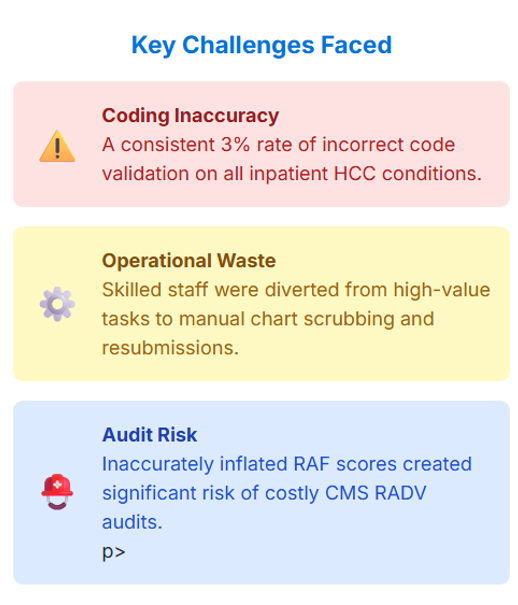
Inpatient HCC conditions can directly impact the overall RAF score. Issues such as incorrectly capturing inpatient conditions in an outpatient setting, past headers, conditions without documented treatment, and resolved conditions in the outpatient/office setting often lead to inaccurate RAF scores and may lead to compliance issues and penalties.
Inpatient Audit: Pinpointing Inaccuracy
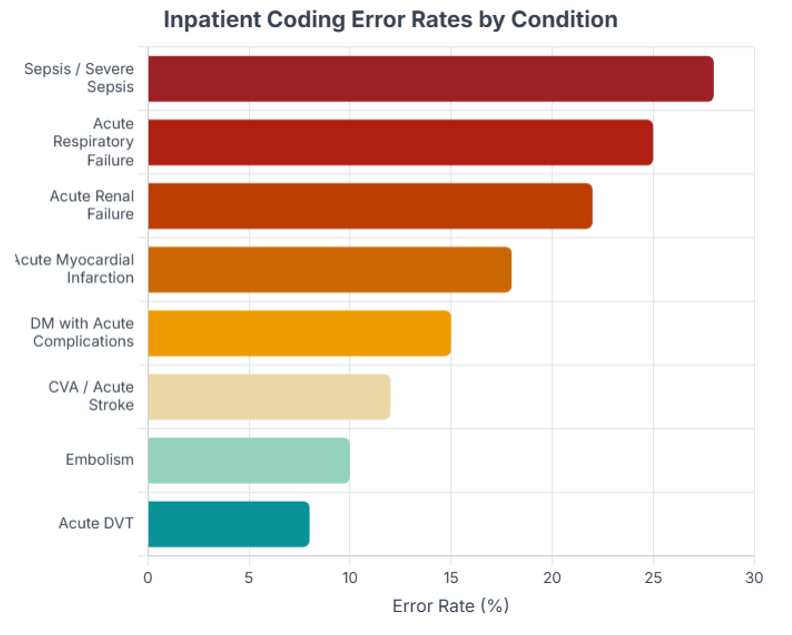
A focused audit of high-impact inpatient conditions revealed significant error rates in manual coding, leading to inflated RAF scores. These inaccuracies highlight systemic weaknesses that a proactive approach can resolve.
Inpatient Audit: Pinpointing Inaccuracy
A focused audit of high-impact inpatient conditions revealed significant error rates in manual coding, leading to inflated RAF scores. These inaccuracies highlight systemic weaknesses that a proactive approach can resolve.
The Perils of Incorrect RAF Submissions
Incorrect RAF score submissions, whether due to under-coding or over-coding, carry severe financial and operational risks that can undermine an organization’s long-term viability.
Financial Recoupments
Over-coding can lead to mandatory recoupments of
overpayments and fines, with penalties exceeding $150 million.
Audit Triggering
Inaccurate submissions attract scrutiny from the CMS Medicare Advantage (MA) RADV program, resulting in costly, time consuming audits.
Revenue Leakage
Under-coding results in lower-than-deserved capitated payments, leading to unrecoverable lost revenue and strained financial viability.
The Results: A Measurable Transformation
Within one month, the proactive framework delivered significant improvements in IP HCC conditions accuracy.